
The Parade Cannons – by David Dorgan
A report in the Evening Post of 6th August 1901 entitled ‘To Defend the Island’ tells us that four cannon were delivered by the freight ship ‘Island Queen’ to be placed at the La Collette Battery. They were described as two 7” (17.78cm) quick firing guns and two 64pdr (29.03kilo) Muzzleloaders.
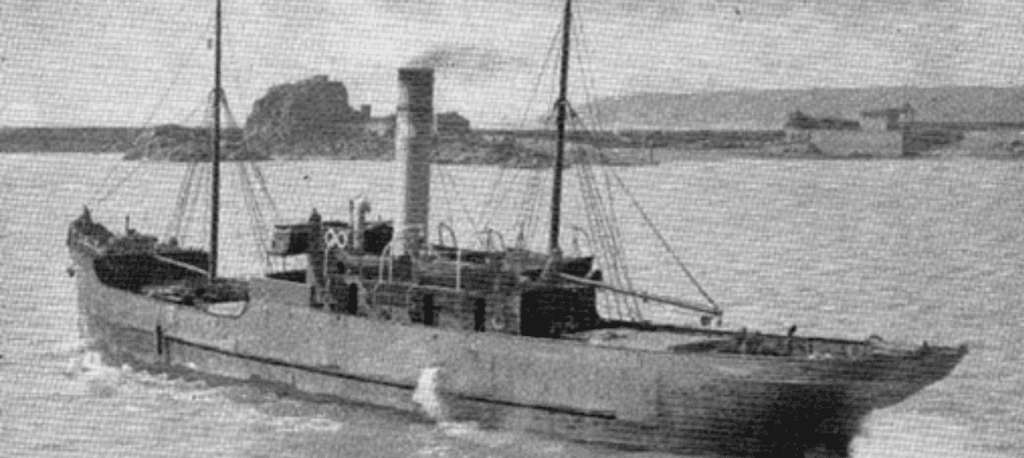
Courtesy: Island Queen – Channelislandshipping.je
Another report, again from the Evening Post of the 27th September 1904 states:
‘Some time ago the Constable of St Helier was informed by the military authorities that they had several pieces of ordnance to dispose of, and Mr Baudins (Constable) entered into correspondence on the subject, with the result that the Parish of St Helier have been presented with five guns. Three of these are 64pdr (29.03 kilo) and two are 9 pounders (90pdr shell). The guns are to be received tomorrow by the town authorities, and as at present arranged, two of the large guns are to be placed either side of the Don Monument, while the remainder will be placed at the lower end of the Parade, facing York Street. In addition to the above guns, a gun taken from the Boers during the South African War, offered by the British Government, will also be handed over tomorrow, and arrangements have been made for the placing of this trophy (a quick firer), mounted on a portable stand, on the main landing at the Town Hall.’
The guns which had been placed in the Parade in 1904 were removed c.2010. The two 2 x 7” (17.78cm) Rifled Breech loading 82cwt(4116kilo) Armstrongs were removed to South Hill in 2020. The 2 x Rifled Muzzleloaders 64pdr (29.03kilo) that were previously on display in front of the Town Arsenal in Nelson Street and then the Parade, were taken to storage at La Saline Quarry, St John.
The two Sir William Armstong patent 7” (17.78cm) Rifled Breech loaders are from different manufacturers, one is dated 1861 from the Royal Carriage Department (Woolwich), marked on left trunnion R.C.D. No. 332 1861. It has an 8ft 6inch (2.62m) barrel of 7inch (17.78cm) bore and Queen Victoria’s Royal Cypher. The initials DB on the right trunnion most likely standing for David Brown.
The second was manufactured by Elswick Ordnance (Armstrongs) in 1862 – E.O. co on the left trunnion, n. 216. It has an 8ft 4inch (2.54m) barrel of 7inch (17.78cm) bore and Queen Victoria’s Royal Cypher.
The ‘I’ on the trunnions are either foundry marks or a casting number.
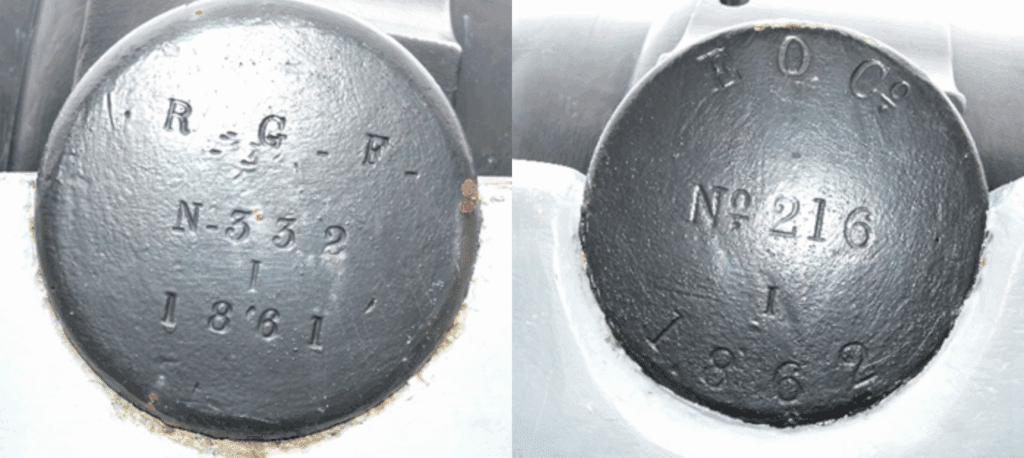
There were only two manufacturers of these guns, the Royal Gun Factory, Woolwich, produced their Armstrongs between 1859 and 1962. Elswick Ordnance produced theirs between 1862 and 1863 both companies supplying the British Government, hence they were sent to Jersey as a matter of defence after being refurbished in 1899.
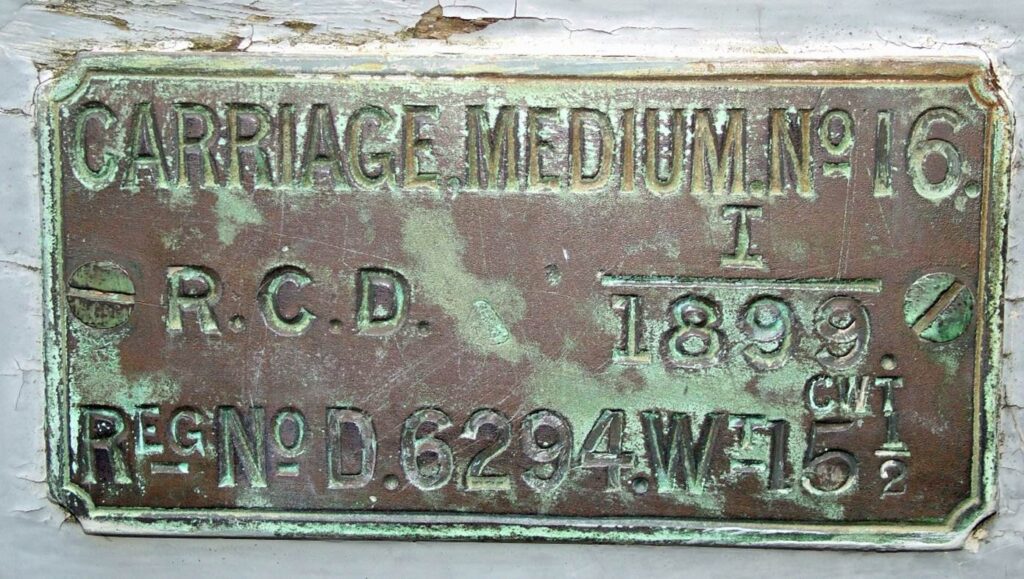
They were remounted on No. 16 medium carriages which were rated to hold up to 15.5cwt (787kilo) guns. The carriage was numbered D6294 and dated 1899.
The guns are painted in a traditional grey paint which was used by both the Royal Artillery and the Royal Navy. This rating plate was attached to the Royal Gun factory 1861 gun but removed and not replaced after refurbishment circa 2007. This picture of the plate was taken in 2007.
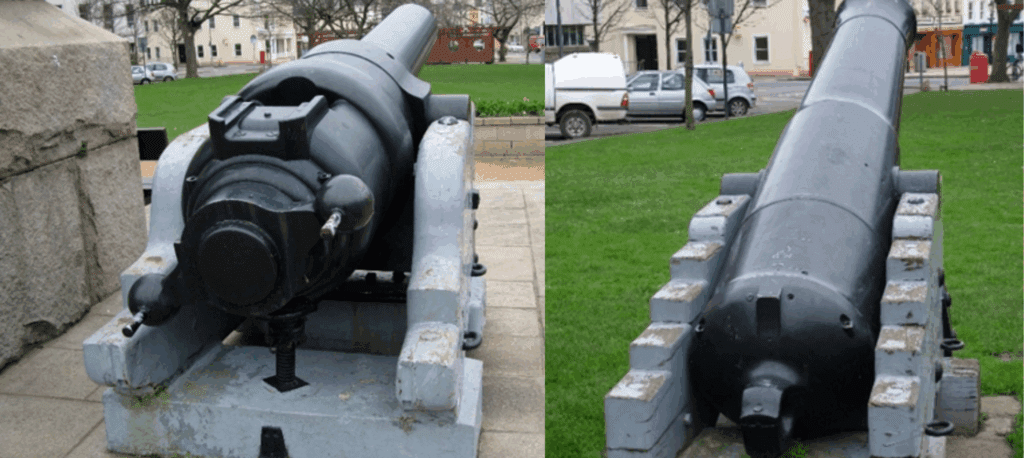
7” (17.78cm) Armstrong Rifled Breech Loader. Rifled Muzzleloader 64Pdr (29.03kilo) cannon
The two 64pdr Rifle Muzzleloaders are both dated 1869 but again they are from different manufacturers, one is from Royal Gun Factory R.G.F no 273 and the second by Sir William Armstong & Co no 142 and both would have been used for coastal defence.
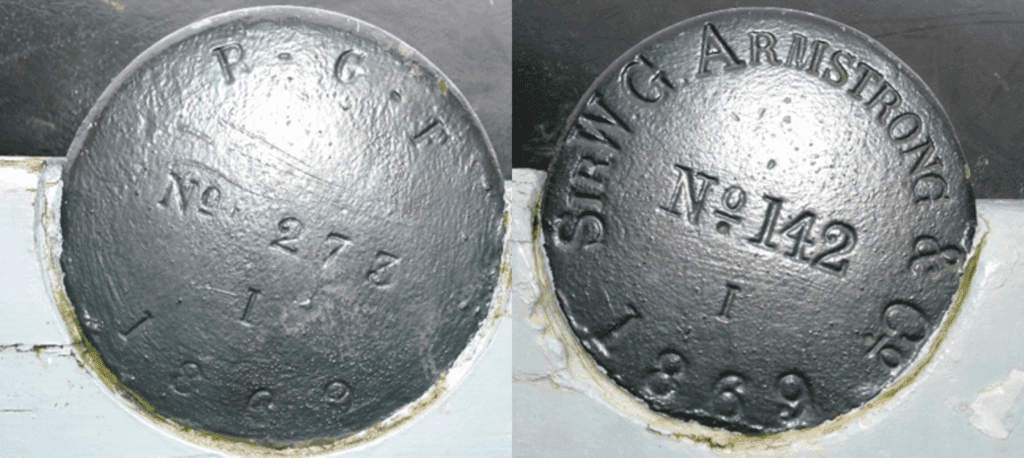
If put in a defensive position either cannon would have been placed on a traversing mount.
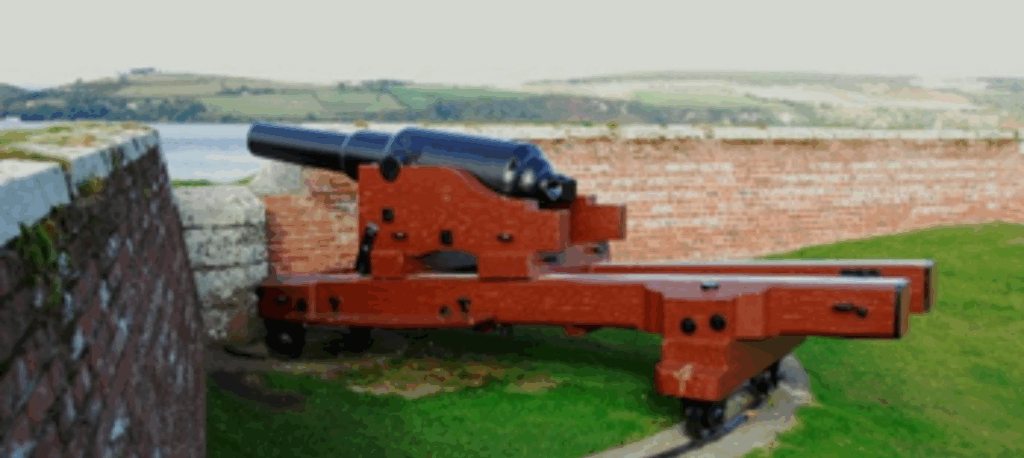
Not Jersey but of a similar type.
There is a connection to the 7” (17.78cm) Armstrong Rifled Breech Loaders and the restoration of the historic H.M.S Warrior based at Portsmouth Historic Dockyard. When it was being restored in 1979 the Maritime Trust were looking for one of this type of guns to reproduce as they were of the type used when the Warrior was upgraded in1867 and the trust could not find any examples in the uk. In 1983 somebody locally sent them a picture of these in the parade and their search was over. They sent a team to Jersey which included a Draughtsman to take the cannon specifications, and when they returned to the UK, had fibreglass reproductions made.
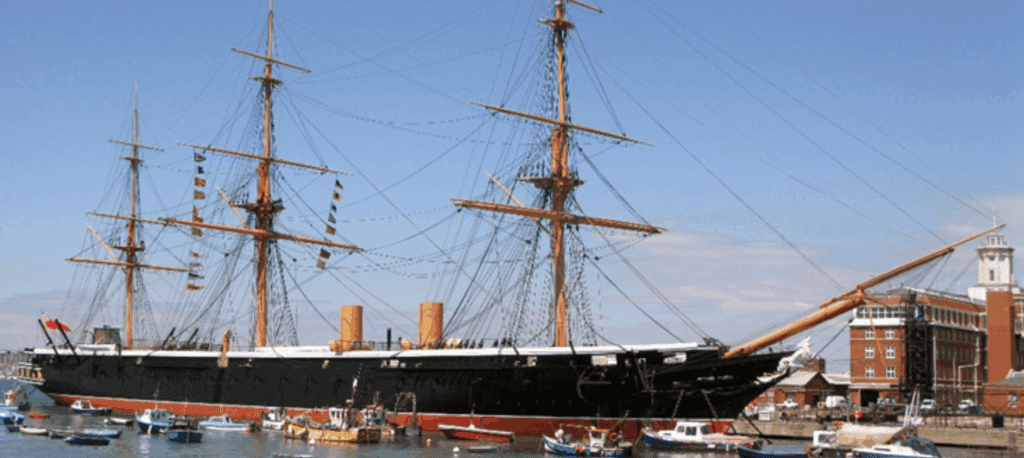
H.M.S Warrior
Another small connection in the same vein was a letter sent to the Jersey Evening Post of 22nd March 1983 from a Mr B.T. Ord of St Brelade who stated that he had a paper knife made from the timbers of H.M.S Warrior. Mr Ord’s family were from Hartlepool where the Warrior was restored. Mr Ord’s grandfather advertised maritime cartography in, of all places, a Methodist prayer book bought in Jersey.